

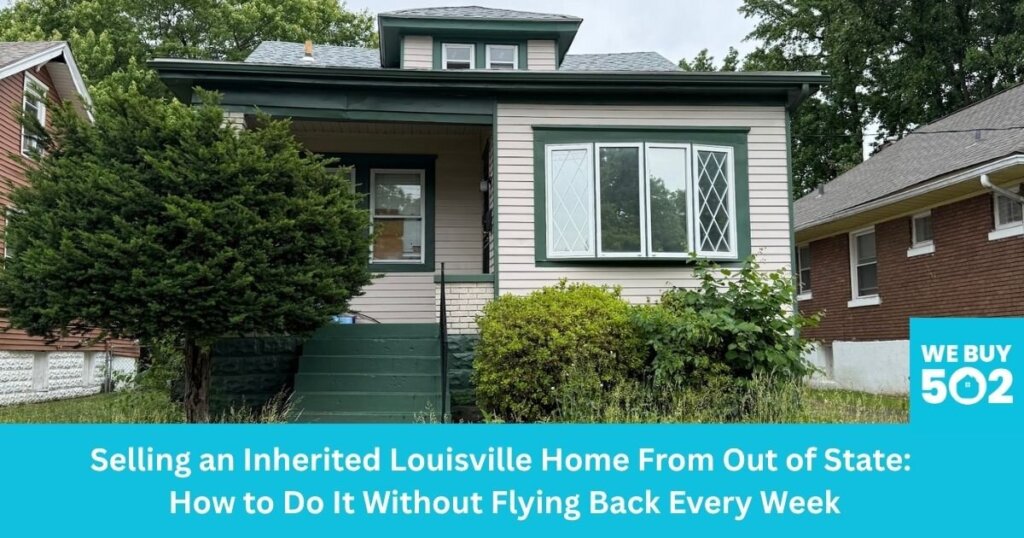
You got the call, flew to Louisville for the services, spent a week helping sort through a lifetime of belongings, and flew back home. Now you’re in another state — Columbus, Nashville, Atlanta, Chicago, wherever you’ve built your life — and there’s a house sitting empty on a Louisville street that you need to figure out what to do with.
Managing an inherited property from out of state is one of the most logistically demanding situations we encounter at We Buy 502. Not because the sale itself is complicated — it usually isn’t — but because the combination of probate requirements, an out-of-state executor, a vacant property that needs monitoring, and a closing process that typically assumes everyone is in the same city creates a set of coordination challenges that most people haven’t dealt with before.
I’m Nyx Sherwin, and I’ve been buying Louisville homes since 2008. A significant number of the inherited properties we purchase come from heirs living outside Kentucky — in many cases, people who grew up in Louisville and moved away years ago, or adult children who inherited a parent’s home and live nowhere near Jefferson County. Here’s what the process actually looks like and how to navigate it without spending more time on planes than necessary.
The First Question: Does the Estate Need to Go Through Probate?
Before anything else can happen with the property, you need to know whether the estate requires probate — because probate is what gives you the legal authority to sell.
In Kentucky, Kentucky District Court handles probate proceedings. As the court’s own documentation confirms, District Court has jurisdiction over the probate of wills and related estate matters. Jefferson County’s probate proceedings are handled through Jefferson County District Court specifically.
Whether the Louisville home needs to go through probate depends on how it was titled. Properties held in joint tenancy with right of survivorship, in a living trust, or subject to a transfer on death deed can transfer outside of probate — the surviving owner or named beneficiary records the appropriate documents with the Jefferson County Clerk and title transfers relatively quickly. Properties held solely in the deceased’s name, or as tenants in common, almost always require probate before they can be sold.
If you’re not sure how the property was titled, a Kentucky probate attorney or title company can pull the deed from the Jefferson County Clerk’s records and tell you definitively. This is worth knowing early — it determines whether you’re looking at weeks or months before the property can be sold. The Kentucky District Court handles these proceedings through Jefferson County, and a local Kentucky probate attorney can file the necessary documents on your behalf without requiring your physical presence for most steps.
What Probate Actually Requires From an Out-of-State Executor
If you’ve been named executor of the estate — or are seeking to be appointed administrator if there’s no will — you don’t necessarily need to be in Louisville for every step. Here’s what typically does and doesn’t require your physical presence.
What you can do remotely:
- Communicate with a Louisville probate attorney who files paperwork on your behalf
- Sign documents via notarized mail or remote online notarization (Kentucky permits remote online notarization, which means you can get documents notarized without being physically present in Kentucky)
- Correspond with the Jefferson County probate court by mail and phone for routine matters
- Coordinate with a local property manager, real estate agent, or cash buyer to handle the property
- Sign closing documents via mail or at a notary near your home
What may require a Louisville appearance:
- Initial filing in some cases (though many Kentucky probate attorneys handle this for you)
- Court hearings if contested issues arise — will disputes, creditor claims, or heir disagreements
- Signing certain documents that require in-person presence
The reality for most straightforward estates is that you can manage the entire process from another state with a good Louisville probate attorney coordinating on the ground. The attorney handles court filings, communicates with the Jefferson County probate court, and keeps you informed. You sign what needs to be signed, notarized where required, and mail documents back.
For the sale itself — if you’re selling to a cash buyer — closing can be handled entirely remotely. The title company sends documents for remote signing, you notarize your signature near your home, the documents are returned, and the proceeds are wired to your account. You don’t need to be in Louisville on closing day.
The Vacant Property Problem
This is the part that creates the most anxiety for out-of-state heirs, and for good reason. A vacant Louisville home is an active liability. Here’s what can go wrong and what to do about it.
Vandalism and theft. Louisville neighborhoods vary significantly in their vacancy risk. A vacant home in a transitional neighborhood like parts of Portland, West End, or Shawnee carries more risk than a vacant home in Crescent Hill or St. Matthews. In higher-risk areas, aluminum wiring, copper pipes, HVAC units, and appliances can be targeted relatively quickly after a property becomes visibly vacant.
Utility management. You need to decide whether to keep utilities on (which costs money but prevents pipe freezing in a Louisville winter and protects the property) or disconnect them (which saves money but creates risk). Louisville winters are cold enough that a vacant property with no heat in January or February can sustain serious water damage from frozen pipes.
Insurance. Most standard homeowner’s insurance policies have vacancy clauses — if a property is vacant for more than 30 to 60 days, coverage may lapse or be significantly reduced. You’ll likely need a vacant property insurance policy, which costs more than standard homeowner’s insurance but provides proper coverage for the interim period.
City code compliance. Louisville Metro’s property maintenance code requires vacant properties to be maintained — grass cut, no accumulation of debris, exterior in reasonable condition. Louisville Metro code enforcement is active, and violations can result in fines that accrue against the property. If you’re not local, arranging a lawn service and periodic property check-in is essential.
Practical steps: Hire a Louisville property management company or individual property caretaker to do monthly walk-throughs, handle lawn maintenance, and flag any issues. The cost — typically $100 to $200 per month — is far less than the cost of unreported water damage or a city violation. Lock the property properly, change the locks if you don’t know who has keys, and notify Louisville Metro Police that the property is vacant (many jurisdictions offer vacant property registration that results in periodic drive-by checks).
How the Condition of the Property Affects Your Options
Most inherited Louisville homes that we purchase from out-of-state heirs share a common characteristic: they haven’t been updated in years or decades. The home may have been perfectly maintained by your parent or relative, but it reflects the tastes and standards of a different era — avocado appliances, original 1970s bathrooms, carpet over hardwood floors, single-pane windows.
That cosmetic and functional gap between the current state of the home and what Louisville buyers expect from a move-in ready property creates a choice you’ll need to make from a distance: renovate before listing, list as-is on the MLS and accept a lower price and longer timeline, or sell to a cash buyer who accounts for the condition in the offer.
Managing a renovation from out of state is genuinely difficult. You’re hiring contractors you’ve never met in a city you no longer live in, making decisions about materials and finishes remotely, and trusting that the work is being done to standard without being able to check. Cost overruns, timeline slippage, and contractor disputes are hard enough to manage when you’re local — they’re significantly harder from another state.
Listing as-is on the Louisville MLS is an option, but it comes with the same showing coordination challenges we’ve discussed in other blogs. An unoccupied house that needs updating and has limited showing availability due to security concerns isn’t going to attract the strongest buyer pool or offers.
A cash sale to a buyer who walks the property once, makes an offer, and closes on a date you choose — with remote signing available throughout — is the option that minimizes your logistical burden most completely. You deal with the property once, from wherever you are, and it’s done.
The Capital Gains Question for Out-of-State Heirs
Inherited properties receive a stepped-up cost basis for federal tax purposes — meaning your cost basis is the fair market value of the property at the date of your relative’s death, not what they originally paid for it. If your parent bought a Louisville home in 1978 for $45,000 and it’s now worth $190,000, your capital gains exposure isn’t $145,000 — it’s the difference between $190,000 and whatever the property was worth when you inherited it.
If you sell relatively quickly after inheriting — within months of the date of death — your capital gains exposure is often minimal or zero, because the sale price is close to the stepped-up basis. The longer you hold the property, the more appreciation above the stepped-up basis becomes taxable.
There’s also a Kentucky inheritance tax consideration. Kentucky is one of a small number of states that still has an inheritance tax. The tax rate and exemptions depend on your relationship to the deceased — direct descendants (children, grandchildren) are generally exempt from Kentucky inheritance tax, while more distant relatives and non-family beneficiaries face graduated rates. A Kentucky CPA or tax attorney can tell you exactly what applies to your situation.
We covered capital gains on Kentucky property in more detail in our blog on capital gains tax on inherited Kentucky property — that blog addresses the tax mechanics in depth.
Coordinating With Other Heirs From a Distance
Out-of-state inherited property situations often involve multiple heirs, not all of whom live in the same state or necessarily agree on what to do with the Louisville home. We covered the sibling disagreement scenario in depth in our blog on selling an inherited Louisville home when siblings disagree, but the out-of-state dimension adds complexity.
When heirs are geographically dispersed — one in Louisville, one in Cincinnati, one in Phoenix — coordinating a decision can feel like herding cats. A concrete cash offer with a specific number and a specific closing date gives everyone the same information at the same time and forces a decision rather than an ongoing conversation. Either the offer is acceptable to all heirs and you move forward, or it isn’t and you make a different plan — but at least the conversation is grounded in a real number rather than speculation.
What Our Process Looks Like for Out-of-State Sellers
When we work with out-of-state heirs on a Louisville property, here’s how the process typically unfolds.
First contact is a phone call or form submission. We ask about the property, the estate’s status (is probate open, is there a will, who has authority to sell), and your timeline.
Walk-through: we schedule a time to access the property — using a key you’ve arranged to leave, or one you’ve mailed us — and I walk the house and assess its condition. You don’t need to be there.
Written offer within 24 hours of the walk-through. We email or mail the offer for your review. If there are multiple heirs, we send it to whoever you designate to coordinate the response.
Contract and title: once you accept, we send the purchase agreement for remote signing. The title company opens escrow and handles all coordination with the Jefferson County probate court if the estate is still open.
Closing: documents are sent to you for remote signing and notarization near your home. You never need to fly back to Louisville unless you want to.
Proceeds wire to your account on closing day. Done.
We’ve closed transactions where the out-of-state seller was in every time zone in the continental U.S. The logistics are manageable when the buyer and title company know what they’re doing.
For more context on how the broader probate and inherited property process works, our Kentucky probate selling guide covers the legal process in detail, and our Shelby Park probate case study shows what a real transaction looks like from start to finish.
FAQ: Selling a Louisville Home From Out of State
Q: Do I need to come to Louisville to sell an inherited home? A: For a cash sale, typically no. The walk-through doesn’t require your presence, closing documents can be signed remotely, and proceeds are wired to your account. You may need to arrange access to the property for the walk-through — either mailing a key or having a local contact provide access. A traditional MLS listing may require more in-person involvement depending on how the process unfolds.
Q: How do I get legal authority to sell the Louisville home if I’m out of state? A: You need to either be named executor in the will and obtain letters testamentary from Jefferson County District Court, or be appointed administrator if there’s no will. A Louisville probate attorney can file the necessary documents on your behalf and handle most of the process without requiring your physical presence in Jefferson County. Remote online notarization is permitted in Kentucky.
Q: What should I do with the property while probate is pending? A: Keep utilities on at a minimum level to prevent freeze damage in winter. Arrange for lawn maintenance and monthly property check-ins — a local property management company or caretaker is worth the cost. Switch to a vacant property insurance policy. Notify Louisville Metro Police the property is vacant. Secure all entry points and change locks if you’re unsure who has keys.
Q: How long does Kentucky probate take? A: Six to twelve months for a straightforward estate. Contested wills, creditor disputes, unclear title, or multiple properties can extend the timeline. Jefferson County’s probate caseload also affects scheduling. A Louisville probate attorney can give you a realistic estimate for your specific situation.
Q: Can I sell during probate before it’s fully complete? A: In limited circumstances, yes — with court approval. The court can authorize a sale of estate property before probate closes, which may be worth pursuing if the property is costing the estate money to carry. Your probate attorney can advise on whether a motion to sell during administration makes sense for your situation.
Q: Will I owe Kentucky taxes on the sale? A: Possibly. Kentucky has an inheritance tax — though direct descendants are generally exempt. The sale itself may generate capital gains depending on the difference between your stepped-up basis and the sale price. A Kentucky CPA or tax attorney should review your specific situation before you close.
The Bottom Line
Selling an inherited Louisville home from out of state involves more moving parts than a typical real estate transaction — probate timelines, vacant property logistics, remote document signing, and coordination across distances. But it’s entirely manageable with the right local contacts and the right buyer.
A cash sale with We Buy 502 minimizes every one of those complications: one walk-through, one offer, remote closing, proceeds wired to your account. We’ve helped out-of-state heirs close on Louisville properties without ever getting back on a plane.
If you’ve inherited a Louisville property and you’d like to know what it’s worth and what the process looks like, contact us or call (502) 849-5950. We’ll walk the property and have a written offer to you within 24 hours of the visit.
