This guide is for informational purposes only and does not constitute legal or tax advice. Consult with a qualified attorney or CPA for advice specific to your situation.
Your parent just died. Or your aunt. Or a cousin you were closer to than most people knew. And now, on top of the grief and the funeral and the thank-you cards, there is a house. Their house. Full of their furniture, their smell, their life. And somehow, you are the one responsible for figuring out what to do with it.
If you are reading this, you probably already know you need to sell the inherited house. You are not confused about that part. You are stuck. The probate paperwork, the tax questions, the siblings who all want different things. It piles up until doing nothing feels easier than doing anything.
That is normal. We have been buying inherited houses across Kentucky since 2008, and I can tell you: most executors go through this exact same freeze. You are not behind. You are not doing it wrong. You just need a place to start.
This is that place. We will cover the probate process, what you can and cannot do as executor, how taxes actually work (spoiler: probably less than you fear), your options for selling, and what happens when family members disagree. If you have questions along the way, call me at (502) 849-5950. No sales pitch. Just answers.
Already know you want to act?Talk to us today — no fees, no obligation, and you’ll have an offer in 24 hours.
Understanding Probate When Selling an Inherited House in Kentucky
Here is the short version: you cannot sell an inherited house in Kentucky until the estate goes through probate (with a few narrow exceptions). The house is still in your loved one’s name. No title company will close on it until someone has the legal authority to sign.
That someone is the executor. And that authority comes from a court document called letters testamentary. Without those letters, you are stuck.
Kentucky Has Its Own Probate Rules
Kentucky has not adopted the Uniform Probate Code that many other states use. So if you have been Googling “how to sell an inherited house” and reading national advice, some of it does not apply here.
The biggest difference? Kentucky does not allow Transfer on Death (TOD) deeds for real property. Bills have been introduced since 2018 to change this. None have passed. In states with TOD deeds, a house can skip probate entirely and pass straight to a named beneficiary. Kentucky does not offer that option for real estate.
What that means for you: probate is almost always required. The only exceptions are if the property was held in a living trust or owned as joint tenancy with right of survivorship.
How Long Does Probate Take in Kentucky?
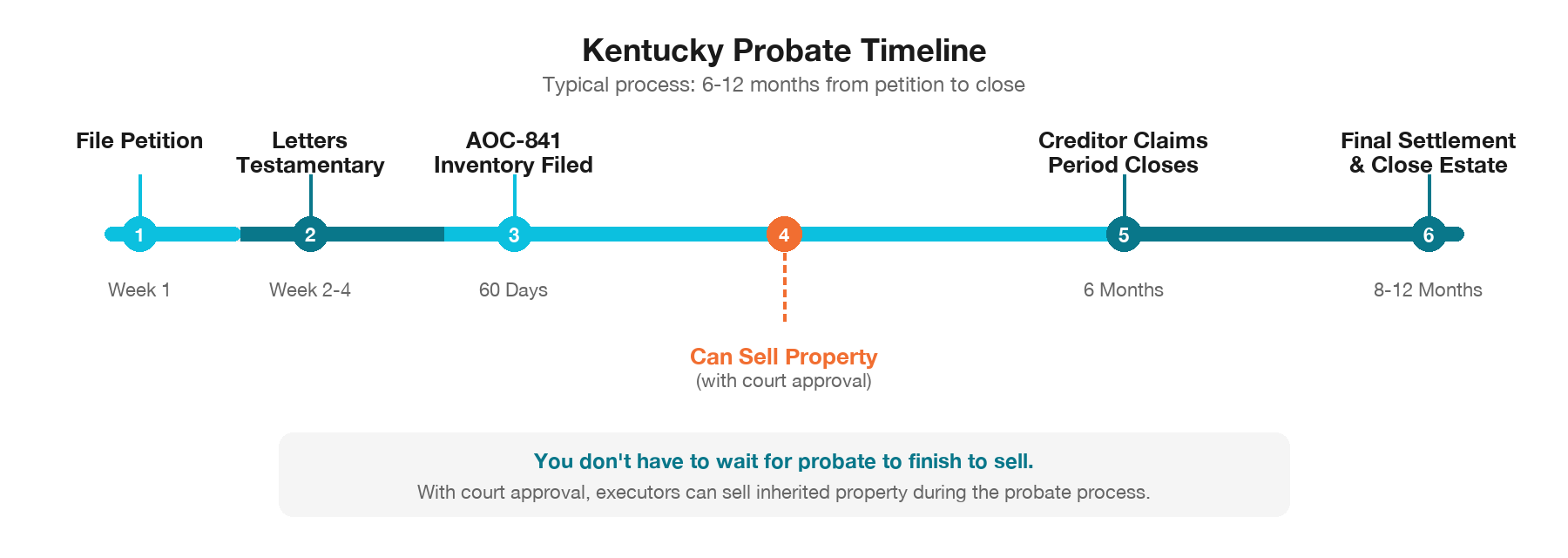
Six to twelve months for a clean case. If the title is unclear, if there are multiple properties, or if heirs are fighting, it takes longer. Sometimes much longer.
The process goes roughly like this:
Filing the will (or petition for intestate administration) with the county court
Appointment of the executor (if there is a will) or administrator (if there is no will, called intestate succession)
Getting letters testamentary from the court, which give the executor legal power to act for the estate
Filing the AOC-841 inventory within 60 days, listing all estate assets and their values
Paying debts and taxes of the estate
Distributing assets to heirs, which may include selling real property
Filing the final settlement with the court
Step 3 is the one that matters most for selling. Until the court hands you those letters testamentary, you cannot sell, sign contracts, or transfer title. Everything waits on that piece of paper.
The Small Estate Affidavit Exception
If the entire estate (not just the house) is worth $30,000 or less, Kentucky lets heirs use a small estate affidavit instead of formal probate. Faster, simpler, cheaper. But $30,000 is a low bar. Most estates that include real property will clear it and need standard probate.
One thing to watch: this threshold used to be $15,000. It was updated to $30,000. If someone gives you advice based on the old number, their information is outdated.
Jefferson County Probate Court
If the inherited property sits in Louisville or Jefferson County, your estate goes through the Jefferson County Probate Court. Every county in Kentucky handles probate through its own District Court. If you live out of state (and many executors do), a lot of the process can happen by phone and mail. But certain filings require you to show up in the county where the person lived.
What an Executor Can (and Cannot) Do When Selling Inherited Property in Kentucky
Being named executor in a will does not give you the green light to sell. Not yet. Your authority comes from the court, not from the document your loved one wrote. Until the court issues letters testamentary, you are an executor in name only.
This catches a lot of people off guard. They think the will says “sell the house and split the proceeds,” so they can just go do that. It does not work that way in Kentucky.
Executor Authority Under Kentucky Law
Once the court officially appoints you, the rules change. Now you have a real legal duty to manage the estate for the benefit of the heirs. The law calls you a personal representative, and it holds you to a high standard. For selling inherited real property, the key document is the executor’s deed under KRS 382.040. That deed is what actually moves the property from the estate to the buyer.
What you can do once you have letters testamentary:
List and sell real property once the court has granted authority
Enter into contracts on behalf of the estate
Make necessary repairs to preserve the property’s value
Pay property taxes, insurance, and utilities from estate funds
What you cannot do without extra steps:
Sell below fair market value without court approval and beneficiary consent (this can expose you to personal liability, and it happens more than you would think)
Sell to yourself or a related party without full disclosure and court oversight
Distribute proceeds before debts and taxes are settled
Ignore the AOC-841 inventory filing (due within 60 days, and the court does not let this slide)
Court Approval for Sales
Sometimes selling an inherited house requires court approval on top of everything else. This comes up when the will is silent about the executor’s power to sell, when the price is below the appraised value, or when heirs object to the deal.
If you need court approval, add 30 to 60 days for the hearing and order. Your probate attorney can tell you whether your situation requires it.
When There Are Multiple Executors
If the will names two or more executors, all co-executors generally have to agree on major decisions like selling. And when co-executors disagree? The whole process slows to a crawl. The court may need to step in to break the deadlock.
Tax Implications of Selling an Inherited House in Kentucky
This is the part that keeps people up at 2 AM. “Am I going to owe $50,000 in taxes on Mom’s house?” Almost certainly not. But the worry is real, so let’s walk through the numbers.
Tax laws change frequently. Verify current thresholds and rates with your tax professional before making decisions based on this information.
The Stepped-Up Basis: Your Biggest Tax Break
When you inherit a house, the IRS does not care what your parents paid for it in 1975. Not even a little. Your tax basis (the number the IRS uses to figure out your gain or loss) resets to the fair market value of the house on the day they died. This is called the “stepped-up basis,” and it works very much in your favor.
Quick example. Say your mother bought her place in Shively in 1972 for $22,000. She passed away in 2026, and the house is worth $165,000. Without the stepped-up basis, selling for $165,000 would stick you with a $143,000 taxable gain. But with it? Your starting point is $165,000. Sell for that, and your capital gain is zero. Zero.
You do need to prove the stepped-up basis, though. That means getting a date of death appraisal, which is a licensed appraiser’s estimate of what the home was worth the day your loved one died. It runs $300 to $500. Get it. If the IRS ever asks questions, that appraisal is your shield.
Most Kentucky families who sell an inherited house within the first year owe little or no capital gains tax, because the sale price is close to the stepped-up basis. The longer you hold the property, the more the market can push the value above your basis, creating a larger taxable gain.
Kentucky Inheritance Tax
Kentucky has an inheritance tax, but it almost never touches the people who actually inherit houses. Spouses, children, grandchildren, parents, siblings: all Class A beneficiaries. Class A pays nothing. Zero. The tax only applies to more distant relatives and people outside the family.
Federal Estate Tax
The federal estate tax has a $15 million per person exemption ($30 million for married couples) under the One Big Beautiful Bill Act. That number is indexed for inflation and has no sunset. Unless your loved one left behind a $15 million estate, this tax does not apply to you.
Capital Gains Tax When You Sell
If the sale price ends up higher than your stepped-up basis, you owe capital gains tax on the difference. But here is the thing: inherited property always gets treated as a long-term gain, even if you sell two weeks after the funeral. Long-term means lower rates: 0%, 15%, or 20% depending on your income.
The tax picture in plain English: Between the stepped-up basis, the Class A inheritance tax exemption, and the $15 million federal estate tax threshold, most Kentucky families owe little or nothing when selling an inherited house. Get the date of death appraisal. Sell within a reasonable window. And talk to a CPA about your specific numbers.
Your Options for Selling an Inherited House in Kentucky
Not every inherited house needs a real estate agent, a fresh coat of paint, and three months of showings. And not every situation calls for a cash buyer, either. Here is how the two main paths compare.
Traditional Agent Sale
Cash Offer (We Buy 502)
Timeline
3-6 months (plus repairs)
14 days average
Repairs Needed
Yes, to maximize listing price
None. We buy as-is.
Commissions & Fees
5-6% agent commission + closing costs
$0. No commissions or fees.
Showings
Multiple showings, open houses
One visit from Nyx. That's it.
Carrying Costs
$300-600/mo while listed
Minimal. Close in 2 weeks.
Certainty
Buyer financing can fall through
Cash. No financing contingencies.
Best For
Move-in ready homes, no time pressure
As-is homes, multiple heirs, fast close
Listing with an agent makes sense when the inherited house is in solid shape, you live close enough to manage showings, and nobody is in a rush. A cash sale makes sense when the house needs work (especially older homes with issues like lead paint), carrying costs are eating into the estate every month, or the family just needs to move forward. We close in as little as two weeks, and the seller pays nothing out of pocket.
Other Options
Keep the inherited house. If you can cover the carrying costs (property taxes, insurance, utilities, maintenance) and the home serves a purpose for your family, keeping it is a real option. But know that vacant inherited houses fall apart faster than anyone expects. And every month of carrying costs is money that could have gone to the heirs.
Rent it out. Becoming a landlord adds layers you may not want right now: tenant screening, rental income taxes, ongoing repairs, and depreciation recapture when you eventually sell. If you already manage rental properties, maybe. But most executors dealing with inherited property are not looking to pick up a rental 80 miles from home.
Sell to a family member. If one heir wants to keep the house and can buy out the others at fair market value, this can work. Get an independent appraisal so everyone agrees on the number, and involve an attorney so nobody feels shortchanged later.
14 days
Average time from offer to close with We Buy 502
$0
Commissions, fees, or closing costs to you
What Happens When Multiple Heirs Inherit a Kentucky Home
This is where things get personal. The law itself is not that complicated when multiple heirs inherit a house. But people are complicated. Siblings with different bank accounts, different memories of the house, different relationships with the person who died. That is where it gets hard.
When All Heirs Agree
The smoothest version of this story. All co-heirs sign the paperwork, the executor handles the sale, and proceeds get split according to the will (or by intestate succession if there is no will). Done. A cash sale makes it even simpler: one offer, one closing, one check split and mailed.
When One Heir Disagrees
More common than you would think. One sibling wants to keep the house. Another needs the cash now. A third moved to Oregon ten years ago and just wants someone to handle it. Kentucky retains dower and curtesy rights that can complicate things further when a surviving spouse is in the picture. If that applies to your situation, talk to an attorney before anyone signs anything.
When heirs disagree, you have a few paths:
Buyout: The heir who wants to keep the house pays the others their share at fair market value
Mediation: A neutral third party helps the family land somewhere everyone can live with
Court petition: The executor can ask the court for authority to sell if the will supports it
Partition Action: The Last Resort
When nobody will budge, any co-owner can file a partition action under Kentucky law. This forces the sale, usually at a court-ordered auction. And court-ordered auctions almost never get full market price.
We have watched partition actions play out. They are slow, expensive, and bitter. Legal fees eat into the proceeds. The house sells for less than it should. Everyone walks away angry.
The way to avoid one: have the conversation early, get an independent appraisal so there is a number everyone can see, and bring in a neutral third party before things go sideways.
How Kentucky Families Have Handled Inherited Property
Every inherited property is different, but some stories come up again and again. Here are two from families we have worked with in Louisville.
Six Siblings, One Grandmother’s House (617 Camp St, Shelby Park)
Jivonnia's grandmother left her Shelby Park home to six grandchildren. Six people with six opinions about what to do with a house that needed work and was full of decades of memories. Jivonnia was the executor. She lived in Louisville but still had to coordinate with siblings who could not agree on anything.
Nobody wanted to gut the place. Nobody could afford to fix it up, either. And every month that passed, the carrying costs kept climbing. Insurance, taxes, utilities, yard work. The longer the inherited house sat there, the worse the math got.
We walked through it with Jivonnia, made a fair cash offer, and closed on her schedule. Each sibling got their share within days.
An Out-of-State Administrator and a Home Full of a Lifetime (1113 Longfield Ave)
When I first talked to LG Rice, he was calling from Claremont, California. His cousin had been a Louisville social worker for 50 years. She passed away without closer relatives, and the court appointed LG as administrator. Intestate succession. No will, no executor named, no roadmap.
The inherited house near Churchill Downs was in rough shape. There was a car sitting in the driveway. Two storage units packed with her belongings. And LG did not know a single person in Louisville.
We took care of all of it. First phone call to closing: 30 days. LG recorded a video afterward and called the process "professional, efficient, honest." He said we showed "utmost integrity" and "compassion." Those are his words, not mine. And they are the reason I do this work.
If you are dealing with an inherited property from out of state and have no idea where to start, call me at (502) 849-5950. I have been in LG's shoes with families. I know what it feels like to be overwhelmed by someone else's house from 2,000 miles away.
Every inherited property situation is different. Tell us about yours and we'll walk you through your options.
Louisville Metro: What Local Executors Should Know
A few Louisville-specific things that catch people off guard.
The vacant property ordinance. Louisville Metro requires you to register vacant properties and keep them up to code. If the inherited house sits empty during probate (and it usually does), expect notices from Metro Government. Mow the yard. Lock the doors. Keep it from looking abandoned. Code violations mean fines, and fines eat into the estate.
Jefferson County Probate Court handles all probate filings for Louisville properties. That is where executor appointments, inventory filings, and sale approvals go through.
Carrying costs add up fast. A typical inherited house in Louisville costs $300 to $500 per month to hold: property taxes, insurance, basic utilities to keep pipes from freezing, and minimum yard maintenance. Over a 12-month probate? That is $3,600 to $6,000 gone before you see a dollar from the sale. Every month you wait costs the estate money.
Frequently Asked Questions
Do I need to go through probate to sell an inherited house in Kentucky?
Almost always, yes. Kentucky has not adopted the Uniform Probate Code and does not allow Transfer on Death deeds for real property. Unless the house was held in a living trust or as joint tenancy with right of survivorship, probate is required to transfer title and give the executor authority to sell.
How long does probate take in Kentucky?
A clean probate case typically runs 6 to 12 months. Contested estates or cases with multiple properties, unclear titles, or disputes among heirs can take much longer. Your probate attorney can give you a better estimate based on your situation.
Can I sell an inherited house before probate is complete?
Usually not. You need letters testamentary from the court before you can legally sell property on behalf of the estate. In some cases, the court may grant the executor authority to sell before probate wraps up, but that requires a separate petition and court order.
Do I have to pay capital gains tax on an inherited house in Kentucky?
Most Kentucky families owe little or no capital gains tax because of the stepped-up basis. Your tax basis resets to the fair market value of the house on the date of death. If you sell near that value, your taxable gain is small or zero. Get a date of death appraisal to lock in your basis.
What if my siblings don’t agree to sell the inherited house?
Start with a conversation. If that goes nowhere, look at a buyout (one sibling buys the others out at fair market value), mediation with a neutral third party, or a court petition. As a last resort, any co-owner can file a partition action to force a sale, but those are expensive and rarely end well.
Can an executor sell a house without all heirs agreeing?
It depends on the will. If the will gives the executor broad power to manage and sell estate property, the executor may be able to sell without everyone agreeing. If the will is silent or limited, the executor may need court approval. Talk to an estate attorney about your specific situation.
How much does it cost to hold an inherited house while waiting to sell?
For a typical Kentucky home, carrying costs run $300 to $500 per month. That covers property taxes, insurance, basic utilities, and minimum maintenance. Over a 12-month probate, that is $3,600 to $6,000 just to hold the property before any sale money comes in.
What is a stepped-up basis and how does it affect my taxes?
The stepped-up basis means your tax starting point for an inherited house is what the house was worth when the person died, not what they paid for it 40 years ago. This wipes out most or all of the capital gains tax you would otherwise owe. You need a date of death appraisal to document this value.
Your Next Step
Look, selling an inherited house is not something anyone looks forward to. It is one more thing on a list that already feels too long. But the longer the house sits, the more it costs, and the heavier it weighs.
You do not have to figure this out alone. And you do not have to decide anything today.
If you want to talk it through, call me at (502) 849-5950. I am Nyx, and I have been helping Kentucky families sell inherited houses for close to 20 years. No pressure, no obligation, no weird sales tactics. Just a conversation about your situation and what makes sense for you and your family.
Ready to discuss your options? Get a free, no-obligation cash offer.
This guide is for informational purposes only and does not constitute legal or tax advice. Tax laws and probate procedures change. Consult with a qualified attorney or CPA for advice specific to your situation.