
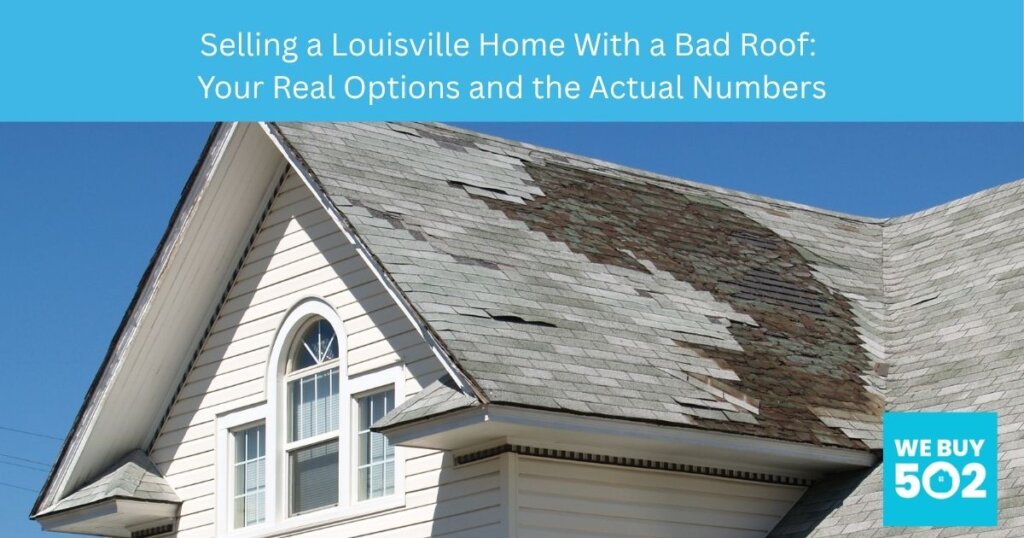
The home inspector’s report came back and the roof section wasn’t pretty. Or maybe you already knew — you’ve been watching those shingles curl for two years, putting off the conversation because roof replacement is expensive and the timing was never right. Now you’re trying to sell and the roof is the thing standing between you and a closed deal.
Roof problems are one of the most common deal-killers in Louisville home sales, and one of the most misunderstood. Sellers assume they have to replace the roof before listing. Buyers assume a bad roof is a bigger problem than it often is. Lenders have specific requirements that vary by loan type. And the actual cost of replacing a roof in Jefferson County covers a wider range than most people expect.
I’m Nyx Sherwin. I’ve been buying houses in Louisville since 2008, and I’ve walked through hundreds of properties with roof issues ranging from a few missing shingles to full structural decking compromise from years of water infiltration. Here’s what you actually need to know about selling a Louisville home with a bad roof — including when fixing it makes financial sense and when it doesn’t.
What Counts as a “Bad Roof” in the Louisville Market
Not all roof problems are equal, and the category your roof falls into affects every decision that follows.
End-of-life asphalt shingles. Most Louisville homes built between 1970 and 2000 have asphalt shingle roofs with a 20 to 30 year lifespan. If your roof is 22 years old and showing granule loss, curling, and general wear without active leaks, it’s at the end of its life but not necessarily an emergency. Buyers and lenders treat this differently than active damage.
Active leaks and water damage. If water is getting into the house — stained ceilings, wet attic insulation, damaged decking — that’s a different category entirely. Active leaks create mold risk, structural risk, and are viewed as a serious defect by both buyers and lenders. This is the situation that requires the most urgent attention.
Storm damage. Louisville gets its share of severe weather — high winds, hail, ice storms. Storm-damaged roofs may be partially or fully covered by homeowner’s insurance. If you haven’t filed an insurance claim and there’s visible hail or wind damage, that’s worth investigating before you spend any money on repairs. An insurance adjuster’s assessment costs you nothing.
Missing or damaged sections. Partial damage from fallen limbs, flashing failures around chimneys or vents, or isolated sections of deterioration are often repairable rather than requiring full replacement. A roofing contractor’s inspection can tell you whether you’re looking at a $2,000 repair or a $12,000 replacement.
What Louisville Lenders Actually Require
This is where roof problems most commonly derail traditional Louisville home sales, and understanding the specific requirements by loan type helps you know exactly what you’re dealing with.
FHA loans are the most common loan type for first-time Louisville buyers, and FHA has the strictest property condition requirements. FHA appraisers are required to flag roofs with a remaining useful life of less than two years, active leaks, or missing shingles that expose the decking. A flagged roof typically requires repair or replacement before the loan will fund. This is not negotiable with the lender — it’s a program requirement from the U.S. Department of Housing and Urban Development.
VA loans have similarly strict requirements for properties purchased by eligible veterans. VA appraisers flag the same conditions FHA appraisers do, and the VA’s minimum property requirements require the roof to be in a condition that prevents moisture penetration and has reasonable future utility.
Conventional loans (Fannie Mae and Freddie Mac) are somewhat more flexible, but appraisers are still required to note roof condition and flag significant deficiencies. A severely deteriorated roof on a conventional purchase can still result in a condition requirement from the lender.
Cash buyers have no lender requirements at all. This is one of the most practical reasons why a cash sale is the cleanest path when a roof problem is severe — there’s no appraisal, no lender review, and no condition requirements. We buy the house in its current condition and deal with the roof ourselves after closing.
The practical implication of all this is that a Louisville home with a bad roof immediately loses a significant portion of its potential buyer pool. FHA buyers — a large segment of the Louisville market — simply can’t purchase it without repairs. You’re left competing for conventional and cash buyers at a price that reflects the roof condition, which brings us to the cost question.
What Roof Replacement Actually Costs in Louisville
Louisville roofing costs vary based on roof size, pitch, material choice, and the extent of decking damage underneath. Here’s a realistic range based on what Jefferson County contractors quote in the current market.
Architectural asphalt shingles (the Louisville standard): $8,000 to $16,000 for a typical 1,500 to 2,500 square foot single-story home. Larger homes, steeper pitches, and multiple layers requiring tear-off push costs higher.
Partial repair rather than full replacement: $1,500 to $5,000 for isolated sections, flashing replacement, or limited shingle repair where the overall roof is sound. Worth getting a roofing contractor assessment before assuming full replacement is necessary.
Decking replacement if water damage is present: Add $2,000 to $6,000 on top of shingle replacement costs if the underlying decking is compromised from water infiltration. This is the variable that can turn a $10,000 roof job into a $15,000 one.
Insurance coverage: If the damage is storm-related — hail, wind, falling debris — your homeowner’s insurance may cover most or all of the replacement cost minus your deductible. Louisville has seen multiple significant hail events in recent years, and many homeowners have qualifying damage they haven’t pursued. If you haven’t had a professional insurance inspection, do it before you spend a dollar of your own money.
The Math on Fixing the Roof vs. Selling As-Is
Here’s where we get to the decision most Louisville sellers are actually trying to make. Let’s use a concrete example.
Your Louisville home is worth $190,000 in good condition. It needs a full roof replacement that’ll cost $13,000. You’re deciding whether to replace the roof before listing or sell as-is to a cash buyer.
Fix the roof and list:
- Roof replacement cost (out of pocket upfront): -$13,000
- Sale price after roof replacement: $190,000
- Realtor commission (6%): -$11,400
- Closing costs (1.5%): -$2,850
- Buyer concessions and other costs: -$4,000
- 60-day carrying costs: -$3,200
- Net proceeds: approximately $155,550
- Timeline: 3 to 4 months
- Upfront cash required: $13,000
Sell as-is to We Buy 502:
- Cash offer accounting for roof condition: $158,000
- No repairs, no commission, no concessions
- Closing costs covered by buyer
- Net proceeds: $158,000
- Timeline: 2 to 3 weeks
- Upfront cash required: $0
In this scenario, selling as-is to a cash buyer actually nets more than replacing the roof and listing — by about $2,450 — and does so without requiring $13,000 in upfront cash, without the 3 to 4 month wait, and without the risk of the deal falling through after a buyer’s inspection.
This isn’t always how the math works out. If your roof repair is minor ($2,000 rather than $13,000) and opens up your buyer pool significantly, fixing it before listing can make sense. But for full roof replacements, the numbers frequently favor selling as-is once you account for all the costs of the traditional path.
Kentucky Disclosure Requirements for Roof Problems
Kentucky’s residential disclosure requirements apply to roof conditions the same way they apply to foundation issues and other material defects. If you know the roof is at the end of its life, has active leaks, or has sustained damage, you’re required to disclose that on the Kentucky Residential Property Disclosure form.
The temptation to minimize or omit roof problems in the disclosure is understandable — sellers worry it will kill the deal. But non-disclosure of a known material defect creates post-closing liability that is far more expensive than the roof itself. Kentucky courts have held sellers responsible for repair costs, diminished value claims, and in some cases legal fees when known defects weren’t disclosed.
Disclose what you know. It protects you legally and it’s the right thing to do. If a buyer walks because of an honest disclosure, they were going to walk anyway when the inspector found it — and the inspector always finds it.
How We Handle Roof Problems at We Buy 502
When I walk a Louisville property with roof issues, I’m looking at a few things: the visible condition of the shingles, any signs of interior water damage (stained ceilings, soft spots in the attic), the age of the roof relative to typical Louisville weather exposure, and whether there’s evidence of insurance-eligible storm damage.
Based on what I see, we either use our own assessment or bring in a roofing contractor for a specific estimate before we make the offer. That number feeds directly into the offer calculation — we’re not guessing or applying a flat deduction. You get a written offer that reflects the actual condition of the property.
If there’s storm damage that appears insurance-eligible, I’ll tell you that before we finalize the offer — because if your insurance covers $10,000 of the $13,000 roof replacement, that changes your options significantly and potentially changes whether a traditional listing makes more sense.
This kind of straightforward assessment is what separates a genuine cash buyer from someone who makes lowball offers hoping you don’t know what the property is worth. You can read more about how we approach as-is purchases in our foundation problems blog, which walks through the same calculation logic for a different type of condition issue.
FAQ: Selling a Louisville Home With a Bad Roof
Q: Do I have to replace the roof before selling my Louisville home? A: No. You have options. You can replace the roof and list at full market value, list as-is at a reduced price targeting cash or conventional buyers only, or sell directly to a cash buyer who will purchase the property in its current condition. The right choice depends on your specific repair cost, your timeline, and your financial situation.
Q: Will my homeowner’s insurance cover the roof replacement? A: If the damage is storm-related — hail, wind, falling debris — it may. Contact your insurance company and request an inspection before spending any of your own money. Louisville has seen multiple significant weather events that left many homeowners with qualifying damage they haven’t pursued. An insurance claim costs you nothing to file.
Q: How much does a roof replacement cost in Louisville? A: A typical full replacement using architectural asphalt shingles runs $8,000 to $16,000 for a standard Louisville home, depending on size, pitch, and whether the underlying decking needs replacement. Get at least two quotes from licensed Jefferson County roofing contractors before deciding.
Q: Will FHA buyers be able to purchase my home with a bad roof? A: Generally no. FHA requires the roof to have a remaining useful life of at least two years and prohibits active leaks or exposed decking. A home with a failing roof effectively eliminates FHA buyers from your pool, which is a significant portion of the Louisville market. Conventional buyers have more flexibility but will still factor the condition into their offers.
Q: How does a bad roof affect my Louisville home’s sale price? A: It depends on severity. A roof at end-of-life typically reduces sale price by the replacement cost plus a negotiation buffer — buyers want to be compensated for the hassle and risk. An actively leaking roof with interior damage reduces value by the roof replacement cost plus remediation costs for any water damage. In both cases, the reduction often exceeds what you’d spend replacing it, which is why the repair-vs-sell-as-is calculation matters.
Q: How long does it take to close if I sell my Louisville home as-is with a bad roof? A: We can typically close in 14 to 21 days. The roof condition doesn’t extend our timeline — we’ve already accounted for it in the offer. Call us at (502) 849-5950 and we can walk the property and have a written offer to you within 24 hours of the visit.
The Bottom Line
A bad roof is a real problem in a Louisville home sale, but it’s a solvable one. The question isn’t whether you can sell — you can — it’s which path makes the most financial sense given your specific repair cost, timeline, and buyer pool realities.
Get a roofing estimate, check with your insurance company, and run the numbers on both paths. If you want a cash offer to use as your baseline, contact us or call (502) 849-5950. We’ll walk the property, give you our honest assessment of the roof condition, and make you a written offer that reflects what the house is actually worth as-is. No pressure, no obligation, and no surprises after the offer is made.
