
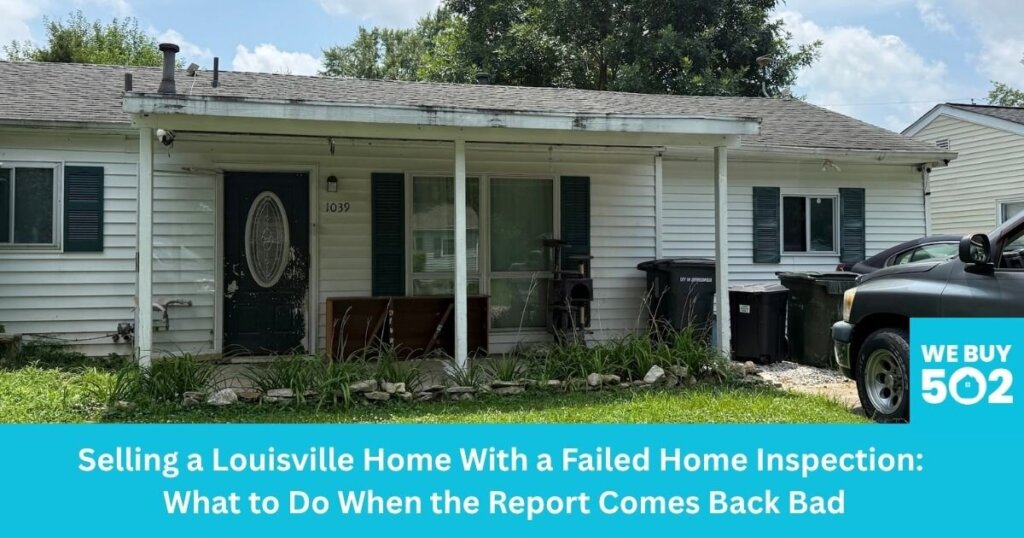
The inspection report arrived and it’s not good. Maybe it’s twelve pages of findings flagged in red. Maybe there’s one item — a structural issue, an electrical problem, active water intrusion — that’s serious enough to stop the transaction in its tracks. Whatever the specifics, you’re now dealing with a buyer who has leverage, a closing date that may be slipping, and decisions to make under time pressure.
This happens in Louisville home sales more than most sellers expect. Louisville’s older housing stock — the brick ranches in Okolona, the two-stories in Germantown, the bungalows in Highlands, the mid-century homes in St. Matthews — accumulates deferred maintenance, aging systems, and the kind of gradual deterioration that doesn’t announce itself until someone runs a flashlight through every corner of the basement and attic. What you thought was a straightforward sale becomes a negotiation over who pays for what.
I’m Nyx Sherwin. I’ve been buying Louisville homes since 2008, and I’ve seen inspection reports that would make a first-time seller’s heart sink. Here’s how to think through your options clearly when the report comes back with more than you bargained for.
What a Home Inspection Actually Is — and Isn’t
Before getting into options, it’s worth being precise about what a home inspection does and doesn’t do, because sellers often misread inspection reports as more catastrophic than they are — or less.
A home inspection is a visual, non-invasive examination of a property’s accessible systems and components. The inspector walks through the house, examines what they can see, tests what they can operate, and documents findings in a report. What it is not: a guarantee of future performance, a code compliance inspection, or a comprehensive structural engineering assessment. Inspectors use language like “recommend further evaluation by a licensed contractor” precisely because they’re identifying potential concerns, not providing definitive diagnoses.
In Louisville, home inspectors examine the roof, foundation, basement, crawl space, HVAC systems, plumbing, electrical panel and visible wiring, windows and doors, insulation, and exterior grading and drainage. A thorough Louisville inspection takes two to three hours for a standard single-family home and produces a report that may run 20 to 50 pages with photographs.
The length of the report doesn’t necessarily correlate with the severity of the problems. A 40-page inspection report on a Louisville home built in 1965 will flag dozens of items — some serious, many cosmetic or minor — simply because there are more things to inspect and more years of aging to document. What matters is the severity and cost of the significant items, not the total page count.
The Most Common Serious Findings in Louisville Inspections
Certain issues come up repeatedly in Louisville home inspections, and knowing which categories carry the most weight helps you triage the report.
Foundation and structural concerns. Louisville’s clay soil and freeze-thaw cycles make foundation movement common, as we covered in depth in our blog on selling a Louisville home with foundation problems. When inspectors flag foundation cracks, bowing walls, or signs of settlement, buyers and their lenders pay close attention. These findings are rarely ignored.
Roof condition. An inspector noting “roof at or near end of useful life” or “missing/damaged shingles with potential for water intrusion” gives buyers immediate grounds for renegotiation. Louisville’s older housing stock means a significant percentage of inspections flag roof condition. We detailed the financial implications in our blog on selling a Louisville home with a bad roof.
HVAC system age and condition. A 22-year-old furnace or a central air unit that doesn’t cool properly gets flagged in virtually every Louisville inspection involving older systems. Buyers use these findings to request credits. We covered HVAC specifically in our blog on selling a Louisville home with HVAC problems.
Electrical concerns. Older Louisville homes may have knob-and-tube wiring, aluminum branch circuit wiring, double-tapped breakers, or panels that insurance companies won’t cover (Federal Pacific Stab-Lok panels are particularly common in Louisville homes built between the 1950s and 1980s). Electrical findings that represent safety hazards carry significant weight with buyers and lenders.
Water intrusion and moisture. Evidence of past or present water in basements or crawl spaces — efflorescence on block walls, water staining, musty odors, active seepage — is one of the most common Louisville inspection findings given our clay soil and precipitation levels. Buyers interpret these findings seriously even when the actual damage is modest.
Plumbing system issues. Galvanized pipes in Louisville’s older homes corrode from the inside over decades, reducing water pressure and eventually failing. Polybutylene piping — common in homes built in the 1980s and early 1990s — is known to be failure-prone. Both show up regularly in Louisville inspections.
Your Four Options When the Inspection Comes Back Bad
Option 1: Make the requested repairs
The buyer submits a repair request or addendum identifying items they want addressed before closing. You hire contractors, complete the work, provide receipts, and close on the original or slightly delayed timeline. This is the most common resolution for minor to moderate inspection findings.
The problem with this option is that repair costs come out of your proceeds, you’re now managing contractors on a timeline you don’t control, and the quality of the work is subject to buyer approval. If the buyer’s re-inspection reveals the repairs weren’t completed satisfactorily, you’re back to negotiations. And some repairs — particularly structural or electrical work — are complex enough that a rushed job ahead of closing creates its own problems.
Option 2: Offer a price reduction or credit
Instead of making repairs, you reduce the sale price or offer the buyer a closing cost credit to account for the inspection findings. This is often the cleaner resolution — you don’t manage contractors, the buyer handles the repairs on their timeline after closing, and both parties know the exact financial impact.
The negotiation here is about how much. Buyers typically request credits based on contractor estimates for the repairs — and those estimates, obtained by buyers who aren’t incentivized to find the lowest bidder, often run high. The negotiation is: you know what the repair actually costs in the Louisville market, and the buyer’s estimate may be inflated. Getting your own contractor estimates to counter with is almost always worth doing before you agree to any credit.
Option 3: Stand firm and risk the buyer walking
You can refuse repairs and credits entirely and let the buyer exercise their inspection contingency. They walk, your earnest money is returned to them, and you’re back on the market. Sometimes this makes sense — if the buyer’s requests are genuinely unreasonable relative to the actual condition of the property, calling their bluff is the right move.
The risk is that the next buyer’s inspector finds the same things, and the same negotiation happens again. And now you’ve lost time, disclosed the inspection findings to yourself (which creates a disclosure obligation), and potentially taken the property off-market during a period when serious buyers were looking. Standing firm works best when the market is strong enough that another qualified buyer is likely to appear quickly.
Option 4: Release the buyer and relist — or pivot to a cash sale
If the gap between what the buyer wants and what you’re willing to do is too wide, letting the transaction fall apart and reconsidering your approach may be the right move. This is the option that’s least discussed but often most rational when the inspection reveals problems significant enough that any financed buyer is going to face the same lender requirements and the same leverage.
When that’s the situation — when the inspection findings are serious enough that every financed buyer is going to have the same conversation — a cash sale sidesteps the whole process. We buy the house in its current condition, the inspection report is informational rather than leverage for renegotiation, and the offer we make already accounts for what we saw during our own walk-through.
The Inspection Contingency: What Sellers Need to Understand
In a standard Louisville purchase contract, the buyer has an inspection contingency — a specified period (typically 10 to 15 days after contract acceptance) during which they can conduct inspections and either proceed, negotiate, or terminate the contract and recover their earnest money.
The contingency gives the buyer significant leverage because walking away costs them very little. The inspection itself runs $300 to $500 for a standard Louisville home. If they don’t like what they find, they terminate and move on. For the seller, a termination means weeks lost on the market, potential re-disclosure obligations, and the need to find another buyer.
This asymmetry — the buyer has low-cost exit options, the seller has high-cost exit consequences — is exactly why inspection findings create disproportionate seller anxiety. The buyer is negotiating from a position of low risk. The seller is negotiating under time pressure with a deal that may fall apart.
Understanding this dynamic helps you negotiate more rationally. When a buyer makes an inspection request, evaluate it against two questions: first, is this something I’d have to address for any financed buyer? And second, what is the actual cost in the Louisville market to remediate this finding? Those two numbers — how certain is it, and what does it actually cost — should drive your response rather than the emotional weight of receiving a 40-page inspection report.
When to Get Your Own Pre-Listing Inspection
One of the most useful things a Louisville seller with an older home can do before listing is order their own pre-listing inspection. Here’s why.
A pre-listing inspection done before you put the house on the market gives you time to address findings on your own schedule, at your own cost, with contractors you’ve vetted. You’re not managing repairs in a 10-day inspection contingency window under pressure. You can choose which items to fix and which to disclose and price accordingly. And critically, you go into negotiations knowing exactly what the buyer’s inspector is going to find — which removes the element of surprise that costs sellers money in post-inspection renegotiations.
Pre-listing inspections run the same $300 to $500 as a buyer’s inspection. For a Louisville home with deferred maintenance, it’s often the best investment you can make before listing.
The Math on Repairing vs. Selling As-Is After a Failed Inspection
Here’s a realistic Louisville scenario. You’re under contract at $205,000. The inspection comes back with: roof at end of life ($11,000 to replace), HVAC system that’s 20 years old and showing strain ($9,000 for full replacement), and evidence of past basement water intrusion ($4,500 for drainage and waterproofing). Total repair request: $24,500.
Make all repairs and close at the original price:
- Repairs funded upfront: -$24,500
- Original sale price maintained: $205,000
- Realtor commission (6%): -$12,300
- Closing costs (1.5%): -$3,075
- Extended carrying costs while repairs complete: -$2,500
- Net: approximately $162,625
- Upfront cash required: $24,500
Offer a $15,000 credit instead of repairs:
- Credit to buyer at closing: -$15,000
- Sale price maintained: $205,000
- Realtor commission (6%): -$12,300
- Closing costs (1.5%): -$3,075
- Net: approximately $174,625
- Upfront cash: $0
- Risk: buyer may still walk if credit seems insufficient
Terminate contract and sell as-is to We Buy 502:
- Cash offer accounting for all three findings: $171,000
- No commission, no repairs, no credits
- Closing costs covered by buyer
- Net: $171,000
- Upfront cash: $0
- Timeline: 2 to 3 weeks, no contingencies
In this scenario, the credit option nets the most — but only if the buyer accepts it and closes, which isn’t guaranteed. The cash sale at $171,000 outperforms the full repair route by $8,375 while requiring no upfront investment. For sellers who don’t have $24,500 sitting around or don’t want the stress of managing three simultaneous repair projects, the math clearly favors the cash sale.
How We Handle Louisville Homes With Inspection Issues
When a Louisville seller contacts us after a deal has fallen through on inspection, we move quickly. We schedule a walk-through within 24 to 48 hours, review what the previous inspection found, and make our own assessment. If the previous inspector’s findings are accurate — and they usually are — we incorporate those costs directly into our offer.
You don’t need to share the inspection report with us, though it’s useful if you do — it saves time and leads to a more accurate initial offer. We’re not going to use the inspection report as a starting point for lowballing; we’re going to use it as one data point alongside our own walk-through to get to a number that reflects what the property is actually worth as-is.
We’ve closed a significant number of Louisville transactions that originated as deals that fell apart after inspection. It’s one of the most common scenarios we encounter, and we’re set up to handle it efficiently.
FAQ: Selling a Louisville Home With Failed Inspection
Q: If a buyer walks on inspection, do I have to disclose the inspection findings to the next buyer? A: Kentucky’s disclosure law requires you to disclose known material defects. Once you’ve received an inspection report identifying material issues, you generally know about those issues — and that knowledge creates a disclosure obligation for subsequent buyers. You cannot selectively ignore what the inspection told you. This is one of the reasons why letting a deal fall apart on inspection and re-listing as if nothing happened is legally risky.
Q: Can I refuse to make any repairs after an inspection? A: Yes. You’re not legally obligated to make repairs. However, the buyer is equally not obligated to proceed if you refuse. In a standard purchase contract with an inspection contingency, the buyer can terminate and recover their earnest money if you won’t address significant findings. Your leverage depends on how much the buyer wants the property and how strong the Louisville market is for your home’s price range and neighborhood.
Q: What’s the difference between an inspection contingency and an as-is sale? A: In a standard sale with an inspection contingency, the buyer conducts an inspection and has the right to request repairs, credits, or walk away. In an as-is sale — whether on the MLS or to a cash buyer — the buyer purchases the property in its current condition with no repair obligations on the seller. However, as-is doesn’t mean the buyer waives their right to inspect; it means they can’t use inspection findings to demand repairs. A cash buyer like us walks the property before making an offer and factors condition into our offer price — so the inspection is built into the front end rather than the back end.
Q: How long does it take to relist after a buyer walks on inspection? A: You can relist immediately after the purchase contract is terminated. However, MLS data tracks days on market and cancellation history — savvy buyers and agents notice when a property has gone under contract and come back. Transparency about why the previous deal fell through is generally the better approach. Trying to hide a prior inspection fallthrough typically backfires when the next buyer’s inspector finds the same things.
Q: Should I get my own contractor estimates before agreeing to buyer inspection demands? A: Absolutely. Buyers obtain estimates from contractors they’ve found, often without price shopping. Independent estimates from Louisville contractors you find may be significantly lower, giving you a rational basis for offering a smaller credit or arguing a repair request is inflated. Never negotiate a credit amount without knowing the actual Louisville market cost for the work.
Q: Can a cash buyer’s offer change after they see the inspection report? A: With We Buy 502, no. We make our offer after walking the property ourselves — we don’t make an offer and then wait for an inspection to renegotiate. The offer we give you accounts for the condition we observed, and that’s the number we close on. This is one of the most practical differences between how we work and a traditional buyer who makes an offer contingent on the inspection results.
The Bottom Line
A failed inspection isn’t necessarily a failed sale — it’s a negotiation. The outcome depends on what the findings are, what they actually cost to address in the Louisville market, and which path best serves your financial interests given your timeline and available capital.
If you’ve had a deal fall through on inspection and you want a fast, clean alternative, contact us or call (502) 849-5950. We’ll walk the property within 48 hours and have a written offer that reflects the actual condition — no contingencies, no renegotiation after the fact.
