
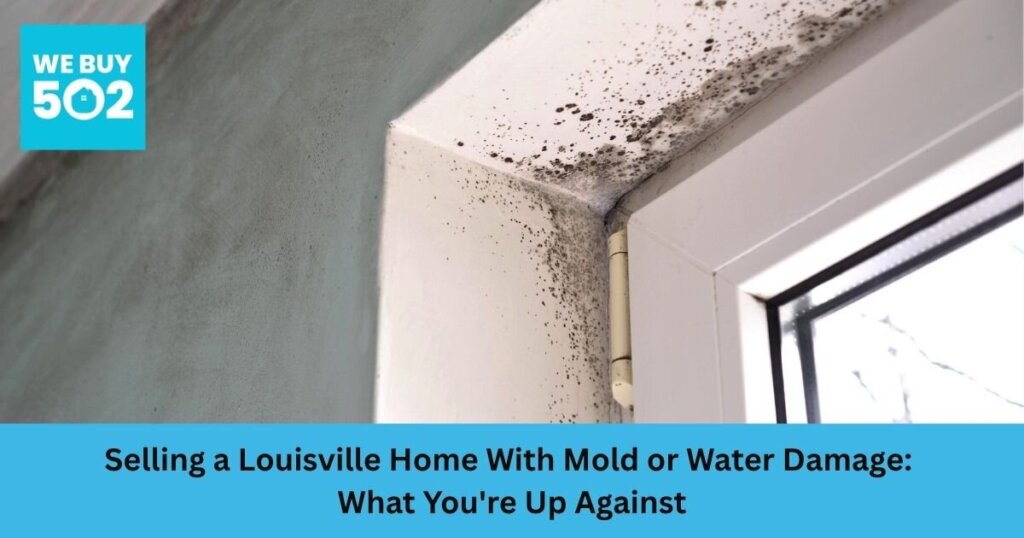
Louisville gets a lot of rain. Situated where the Ohio River bends and fed by tributaries from three directions, Jefferson County averages over 46 inches of precipitation per year — well above the national average. That water has to go somewhere, and for a significant number of Louisville homeowners, some of it ends up in places it was never supposed to be: basements, crawl spaces, wall cavities, and attic spaces where it sits long enough to create mold.
If you’re trying to sell a Louisville home with mold or water damage, you’re dealing with one of the most psychologically charged issues in residential real estate. Buyers react to the word “mold” the way they react to few other things. Some of that reaction is rational. Some of it isn’t. Here’s what’s actually true about mold in Louisville homes, what disclosure and remediation look like, and how to make the best financial decision given your specific situation.
I’m Nyx Sherwin, and I’ve been buying houses in Louisville since 2008. I’ve purchased properties with everything from minor surface mold on basement walls to full structural remediation situations where the first floor had been compromised by years of water intrusion. Here’s what I’ve learned.
Why Louisville Homes Are Particularly Vulnerable
Louisville’s geography creates several converging water intrusion risks that other markets don’t face to the same degree.
The Ohio River floodplain. Neighborhoods on the western side of Louisville — Portland, Shawnee, Riverside, and parts of Rubbertown — sit in or near FEMA-designated flood zones. During significant rain events or upstream weather systems, these areas can experience surface flooding that pushes water directly into structures. Homes in these neighborhoods may have flood damage histories that aren’t always documented.
Clay soil expansion. As we covered in our blog on selling a Louisville home with foundation problems, Jefferson County sits on expansive clay soil that swells when wet and contracts when dry. That movement creates cracks in foundations and basement walls — and cracks are water’s invitation inside. A foundation that was perfectly sealed in 2005 may have gaps today simply from years of soil movement.
Aging housing stock. A large portion of Louisville’s residential inventory was built before modern waterproofing standards were common practice. Homes built in the 1940s through 1970s often have poured concrete or block basement walls with no exterior waterproofing membrane, no interior drainage systems, and original cast iron or clay drain tile that has long since degraded. Water intrusion in these homes isn’t a matter of if — it’s a matter of when and how much.
Louisville’s freeze-thaw cycle. Winter temperatures in Jefferson County routinely cycle above and below freezing multiple times per season. Water that has penetrated masonry freezes, expands, and widens existing cracks — a process that accelerates foundation deterioration and water intrusion over time.
What Kentucky Law Requires You to Disclose
Kentucky’s residential property disclosure requirements are unambiguous on this point: known mold, water damage, and moisture intrusion are material defects that must be disclosed on the Kentucky Residential Property Disclosure form. The form specifically asks about water in the basement or crawl space, past flooding, and known mold.
The critical word is “known.” You’re not required to hire an inspector to find problems you weren’t aware of. But if you know the basement floods during heavy rain, if you’ve seen the water stains on the walls, if you’ve smelled the musty odor — that knowledge creates a disclosure obligation. Attempting to conceal known mold or water damage by painting over staining, using odor maskers, or omitting it from the disclosure form is not just legally risky. It’s fraud.
Post-closing claims from buyers who discover concealed water damage or mold are among the most common real estate litigation scenarios in Kentucky. The remediation costs that would have been factored into your sale price become potential damages you’re liable for — plus legal fees. Disclosure protects you. It’s not just the right thing to do — it’s the financially rational choice.
The Real Cost of Mold Remediation in Louisville
Mold remediation costs vary enormously based on the type of mold present, the extent of the affected area, and whether structural materials need to be replaced. Here’s what Louisville homeowners actually pay:
Surface mold on concrete or block basement walls: $500 to $3,000. This is the most common situation — mold growing on the surface of foundation walls where moisture has been present. Professional remediation involves containment, removal of surface growth, application of antimicrobial treatments, and addressing the moisture source. Often paired with waterproofing work.
Mold in drywall or framing: $3,000 to $10,000 depending on the area affected. When mold penetrates into wall cavities, affected drywall and sometimes framing members must be removed and replaced. This is a more invasive remediation.
Crawl space mold remediation: $3,000 to $8,000. Louisville homes with crawl spaces are particularly vulnerable to mold because of ground moisture and inadequate vapor barriers. Remediation typically involves mold removal, encapsulation of the crawl space floor, and sometimes replacement of deteriorated floor joists.
Attic mold from roof leaks or inadequate ventilation: $2,000 to $8,000. Attic mold is common in Louisville homes with insufficient ridge or soffit venting, or where bathroom exhaust fans vent into the attic rather than outside. Remediation plus ventilation correction is typically required.
Extensive whole-house mold from prolonged water intrusion: $15,000 to $50,000 or more. This is the category where water has been infiltrating for years, affecting multiple systems and structural components. Rare, but not unheard of in Louisville properties that have been vacant or neglected.
Critically, remediation without addressing the underlying water source accomplishes nothing permanent. Mold will return if the moisture problem isn’t fixed. This means remediation costs almost always need to be paired with waterproofing, drainage correction, roof repair, or whatever is allowing water in — which can add significantly to the total.
What Buyers Actually Do When They Find Mold
Here’s the practical market reality in Louisville. When a home inspector’s report comes back with mold — and it will, because inspectors test for it — most buyers fall into one of three groups.
They walk. First-time buyers in particular tend to terminate on mold findings regardless of the actual severity. The word carries enough psychological weight that many buyers simply don’t want to deal with it, even when the actual remediation cost is modest. You lose the deal, go back on the market, and disclose the finding to the next buyer.
They renegotiate hard. Buyers who stay in the transaction use the mold finding as leverage to request a price reduction or seller-funded remediation credit — and they typically request more than the actual remediation cost, because they’re uncertain about what they don’t know. A $3,000 remediation situation routinely results in a $6,000 to $8,000 price concession request.
They proceed with eyes open. Sophisticated buyers — investors, cash buyers, experienced homeowners — see mold for what it is: a solvable problem with a known cost range. These buyers are more likely to proceed, but they’re also more likely to negotiate effectively because they understand the actual cost.
The implication for Louisville sellers is that a mold finding in a traditional sale almost never results in the buyer paying the original offer price. You’re going to absorb the remediation cost one way or another — either by paying for remediation before listing, accepting a price reduction, or losing deals until you find a buyer who prices it in from the start.
The Fix-First vs. Sell-As-Is Math for Louisville Water Damage
Let’s run the numbers on a realistic Louisville scenario. Your home is worth $175,000 in good condition. It has a basement mold situation from a crack in the foundation wall — remediation plus waterproofing will run $9,000.
Fix and list route:
- Remediation and waterproofing (upfront): -$9,000
- Sale price after remediation: $175,000
- Realtor commission (6%): -$10,500
- Closing costs (1.5%): -$2,625
- Buyer concessions: -$3,000
- 75-day carrying costs: -$3,750
- Net proceeds: approximately $146,125
- Upfront cash required: $9,000
- Timeline: 3 to 4 months
Sell as-is to We Buy 502:
- Cash offer accounting for remediation and waterproofing: $152,000
- No upfront costs, no commission, no concessions
- Closing costs covered by buyer
- Net proceeds: $152,000
- Timeline: 2 to 3 weeks
- Upfront cash required: $0
In this scenario the cash sale nets approximately $5,875 more than the fix-and-list route — while requiring no upfront capital and closing in weeks rather than months. The math shifts depending on the severity of the mold situation, but for significant remediation costs, selling as-is frequently comes out ahead once all costs are accounted for.
How We Assess Mold and Water Damage Properties
When I walk a Louisville home with known or suspected mold or water damage, I look at the source of the moisture before I look at the mold itself. A basement wall with efflorescence and surface mold from a hairline crack is a different situation than a basement with active water intrusion from a failed drain tile system. The remediation cost — and therefore the offer — is determined by what it actually takes to fix the underlying problem, not just the surface symptoms.
In most cases I can assess the scope accurately from a walk-through. For situations where the extent of damage is genuinely unclear — where there’s evidence of intrusion behind finished walls, for example — I may bring in a remediation contractor before finalizing the offer to get an accurate number. That process takes a day or two, not weeks.
What I won’t do is make you a lowball offer based on worst-case assumptions about something that can be assessed accurately. The offer you get from us reflects the actual situation, and we’ll explain exactly how we got there.
If you’re dealing with mold on top of other condition issues — an aging roof, foundation cracks, outdated systems — our blog on how to sell a house as-is in Louisville covers how we handle properties with multiple overlapping issues.
FAQ: Selling a Louisville Home With Mold or Water Damage
Q: Do I have to disclose mold if I’ve already remediated it? A: Yes. If you had mold and had it remediated, you should disclose the prior mold condition and the remediation that was performed. Buyers have the right to know the history of the property. Proper remediation with documentation — receipts, photos, contractor reports — actually helps your case because it shows the problem was addressed professionally. Concealing prior mold that you know about creates the same legal exposure as concealing active mold.
Q: Can I just paint over mold or use bleach to clean it before listing? A: You can clean surface mold, but painting over it without addressing the moisture source is not remediation — it’s concealment. The mold will return, and if a buyer discovers you painted over a known mold problem, you’ve created significant legal exposure. Buyers and their inspectors look specifically for painted-over staining in basement and crawl space areas.
Q: Will FHA buyers be able to purchase a Louisville home with mold? A: Not without remediation first. FHA appraisers are required to flag visible mold and active moisture intrusion, and these conditions typically must be remediated before an FHA loan will fund. This effectively eliminates a large portion of Louisville first-time buyers until the mold is addressed. Cash and conventional buyers have more flexibility.
Q: What if the mold is in the crawl space and I didn’t know about it? A: If you genuinely didn’t know — the crawl space was inaccessible, you never had it inspected — then you didn’t have a disclosure obligation for that specific condition. However, once you know about it (including from an inspection you ordered), it becomes a known defect that must be disclosed going forward. Getting an inspection before listing means you can’t claim ignorance of what it reveals.
Q: How does Louisville’s flooding history affect a home sale? A: Homes in FEMA-designated flood zones have mandatory flood insurance requirements that affect buyer financing costs significantly. Properties with documented flood damage history may also have limitations on NFIP insurance availability. We covered this in more detail in our upcoming blog on selling a Louisville home in a flood zone — for properties in Portland, Shawnee, or other western Louisville neighborhoods with flood exposure, the flood zone designation itself is a material fact that must be disclosed.
Q: Is mold always visible or does it hide inside walls? A: Both. Visible mold on basement walls, around windows, or on ceiling tiles is the obvious form. But mold growing inside wall cavities — behind drywall, in insulation, inside HVAC ducts — may not be visible at all, though it typically produces a distinctive musty odor. A professional mold inspection using moisture meters and sometimes air quality testing can identify hidden mold. For Louisville homes with a history of water intrusion, a professional inspection before listing gives you accurate information to work from.
The Bottom Line
Mold and water damage are Louisville realities given our geography, housing stock age, and weather patterns. They’re also solvable problems — the question is who pays to solve them and when. A traditional listing with mold disclosure means absorbing that cost through buyer renegotiation or price reduction. Remediation before listing requires upfront capital and adds time. Selling as-is to a cash buyer accounts for the condition in the offer and closes the transaction cleanly without either of those complications.
If your Louisville home has mold or water damage and you want to know what it’s worth as-is — and how that compares to the fix-and-list route — contact us or call (502) 849-5950. We’ll walk the property, assess the condition honestly, and have a written offer to you within 24 hours.
